
Bastrop Projected and Actual Release
“Projected Release Date” is the official TDCJ field name for a current state prisoner. It reflects the agency’s calculation at that point in time. Sentence data, offense date, eligible good time, classification, statutory exclusions, Board action, detainers, and later judgments can affect it. Save the date on which the field was viewed, since a later result may differ.
Actual release is a completed custody event. For Bastrop County Jail, the jail register or booking-out record can show when local custody ended and whether the person went to the community or another custodian. For TDCJ, a projected field before release is not a historic released-person result. TDCJ’s public inmate search covers only people currently incarcerated in a TDCJ facility, so a former prisoner can disappear.
A pretrial detainee has no set release date. Bond approval, dismissal, acquittal, a personal bond, or a court order can authorize release, but out-processing and other holds still control the physical event.
Find Bastrop TDCJ Release Dates
The TDCJ inmate search accepts last name, first name, TDCJ number, State Identification number, gender, and race. Minimum input is an exact last name plus at least a first initial, a TDCJ number, or an SID. An identifier reduces false matches.
- Confirm that the person is in TDCJ custody, not Bastrop County Jail or FCI Bastrop.
- Search by TDCJ number or SID when possible. Otherwise use the exact last name and first initial.
- Compare identity, location, and offense details before reading the Projected Release Date.
- Record the displayed date and the day it was observed.
- Recheck after a Board vote, new judgment, disciplinary action, or other known change.
The official TDCJ search screen appears in the successful manifest image below.
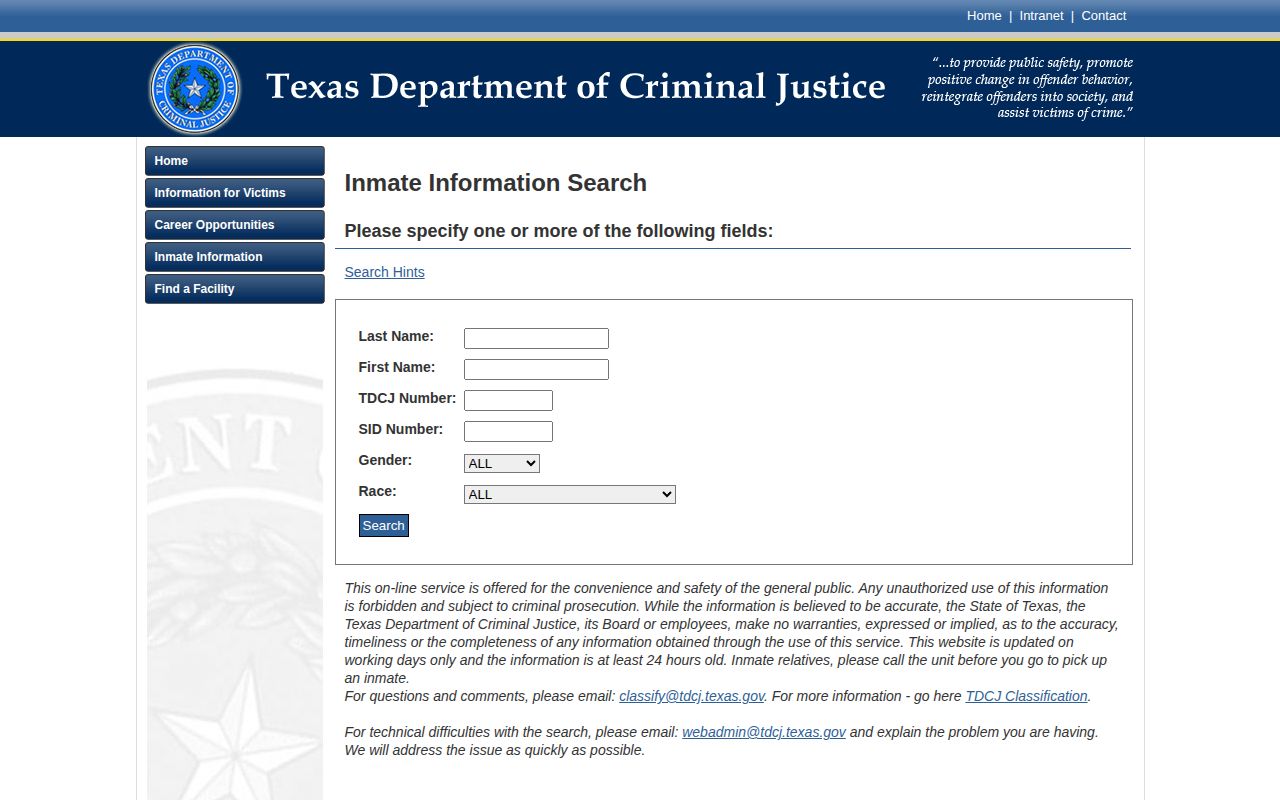
The current-incarceration notice is essential: it prevents the search from being presented as a Bastrop released-person archive.
Bastrop Release Date Information Channels
TDCJ offers more than the web search. The email information service defines projected release date and accepts requests for current or historical information. Supply the full name, TDCJ number, or enough alternate identity detail. The telephone information service is available from 8 a.m. to 5 p.m. Monday through Friday at 936-295-6371 or 800-535-0283. Board status is available at 844-512-0461, and post-vote release status at 512-406-5202.
The official TDCJ information page is captured below.
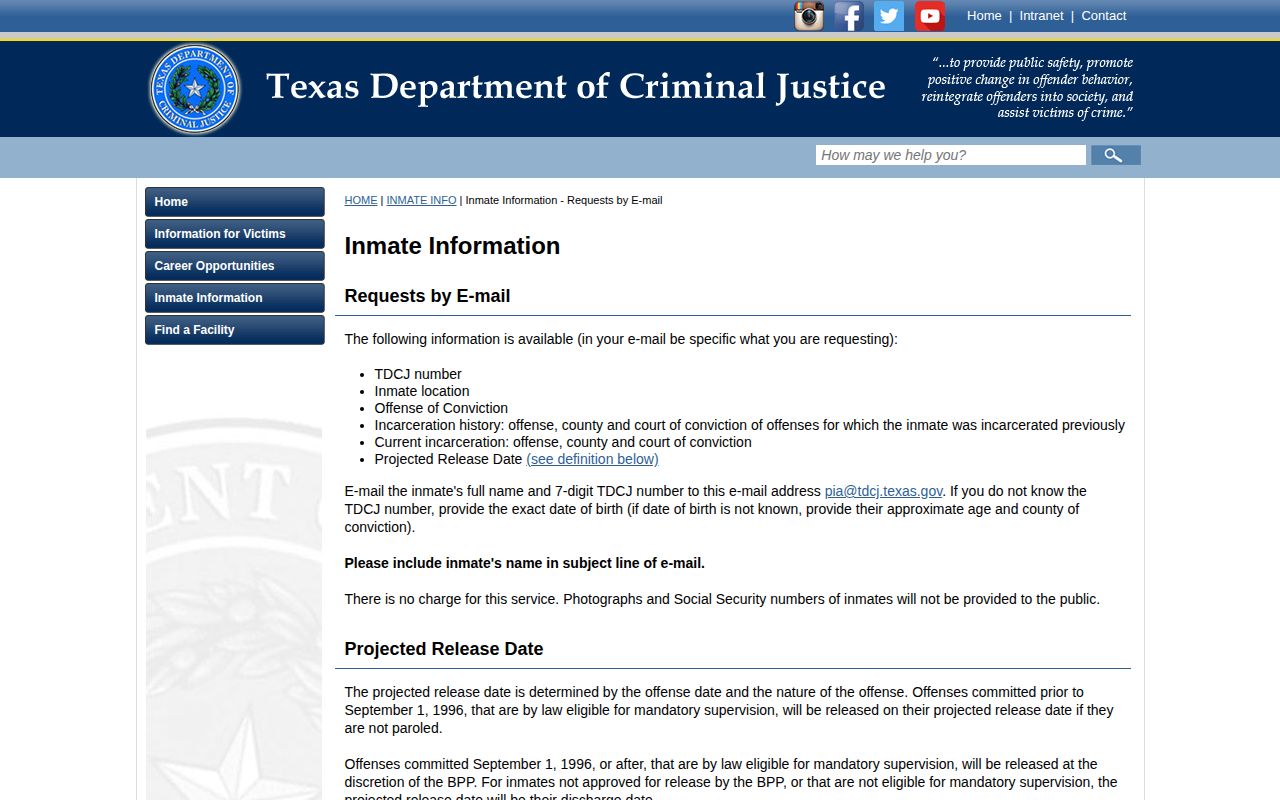
It provides the agency definition and a route when the current-only public search no longer returns the person.
For Bastrop County Jail, call Booking at 512-549-5073 or Jail Records at 512-549-5083. Ask for the recorded release or transfer, not a TDCJ-style forecast. The sentencing court record in Bastrop Odyssey supplies the judgment and jail-time credit, while the jail supplies the executed out date.
Texas Good Time Is Conditional
Government Code Chapter 498 governs state good-conduct time. Section 498.003 ties credits to classification, behavior, and program participation. Section 498.004 makes good time a privilege rather than a vested right and addresses forfeiture and restoration. Good time can affect eligibility for parole or mandatory supervision. It does not shorten the maximum sentence imposed by the court.
Texas has no universal “serve 85 percent” rule for every TDCJ prisoner. That shorthand can produce a false Bastrop County release date. The actual framework depends on the offense date, conviction statute, sentence type, affirmative findings, good-time class, exclusions, and Board decisions. Never calculate a date from sentence length alone.
- Good time
- Credit earned under TDCJ rules that can affect release eligibility.
- Calendar time
- Actual time served, distinct from credited good time.
- Eligibility date
- The point at which review may become possible, not a promised release.
- Detainer
- A request or legal hold that can cause transfer or continued custody.
County jail calculation is different. Bastrop sources publish no local good-time calculator or weekend-release rule. The judgment, lawful jail credit, applicable Texas law, and Sheriff calculation control.
Bastrop Parole Eligibility Formulas
Government Code Section 508.145 contains offense-date and offense-specific parole eligibility rules. A general formula may use calendar time plus good time reaching one-fourth of the sentence or 15 years, whichever is less. Enumerated serious offenses and affirmative findings commonly require actual calendar time of one-half of the sentence or 30 years, whichever is less. Life, capital, and specified offenses have special rules.
Eligibility permits review. It does not order release. The Texas Board of Pardons and Paroles can deny release, choose a later review, or issue a favorable code with a future date or program condition. Favorable action can also be rescinded if new information arrives. Use person-specific status rather than a generic formula.
Mandatory supervision has another framework. Sections 508.147 and 508.149 use actual calendar time plus accrued good time equaling the maximum term, but listed categories are excluded. For eligible cases after the controlling statutory date, a panel can deny release after making both required findings about whether good time indicates rehabilitation and whether release would create danger. A mandatory-supervision calculation is therefore not automatic release for every prisoner.
Why Bastrop Release Dates Change
The projected date is a live agency calculation. A change does not always mean an error. Compare the old and new observation dates, then use the relevant TDCJ or court channel to identify the controlling record.
| Factor | Possible effect |
|---|---|
| Good-time class or forfeiture | Changes eligible credit under Chapter 498. |
| New or corrected judgment | Changes sentence inputs or jail-time credit. |
| Parole Board action | Can deny, defer, condition, approve, or rescind release. |
| Mandatory-supervision exclusion | Can block automatic assumptions under Section 508.149. |
| Detainer or warrant | May cause transfer or continued custody after one term ends. |
| New sentence calculation | Can move the date after record review or correction. |
A court order is legal authority, not proof of the gate time. Likewise, a release date from one agency does not establish freedom from all custody. Ask whether Bastrop County, TDCJ, BOP, USMS, ICE, or another county received the person next.
Confirm Bastrop Actual Release
For county custody, request the jail register or booking-in and booking-out record. Identify the person, booking or SO number if known, and exact custody range. Ask for the recorded release date and time, authority, type, and receiving custodian if releasable. Send Sheriff requests to SORecords@co.bastrop.tx.us, fax 512-549-5195, or BCSO Attn: Open Records, 200 Jackson Street, Bastrop, TX 78602.
For a pending county change, use VINELink Inmate Search, now IVSS-Counties, to request an alert. Preserve its timestamp, then confirm with BCSO. For state custody, use TDCJ IVSS and the post-vote release-status line. A notification helps with timing but remains distinct from the official record.
For a federal prisoner at FCI Bastrop, the BOP locator is authoritative for the public federal status. A future date is projected. A past date with no facility, or “Released/Not in BOP Custody,” ends BOP custody only. Federal supervised release or another custodian may still apply.
Historical confirmation may need a different channel. The current TDCJ web search can stop returning a former prisoner, but that absence does not erase the calculation once displayed. Ask the TDCJ information service for historical details with the full name and TDCJ number. For Bastrop County Jail, the permanent jail register is the stronger archival target.
Read a transfer as a transfer. A Bastrop booking can end because TDCJ, another county, USMS, ICE, or another lawful custodian receives the person. The county date then marks the end of Bastrop custody, not entry into the community. Check the receiving agency next. No official source verified Bastrop County Jail as an ICE contract facility, so such a link must not be assumed.
A later court entry can alter the analysis. New jail-time credit, an amended judgment, a writ, or another sentence may change calculation inputs. Obtain the filed order and compare it with the agency date. Do not substitute personal arithmetic for the corrections calculation. If values conflict, ask the agency that owns the sentence computation.
Records from the sentencing court and the jail solve different parts of a county case. The judgment supplies the term and credited time. The jail record supplies actual release or transfer execution. A dismissal or bond order on one cause may coexist with another hold, so check all cause numbers connected to the booking. Ask Jail Records whether the recorded disposition applied to the full custody episode.
After a favorable parole decision, read the decision code before expecting release. FI-1, FI-2, and FI-R variants do not all mean the same timing or conditions. A program placement may still be required. New facts can lead to rescission. The post-vote status line is designed for the stage between Board action and physical release, and the later supervision record confirms what followed.
Do not convert the projected date into a claim about where the person will go. Release may lead to parole, mandatory supervision, a residential placement, another jail, federal custody, or another lawful custodian. The destination field and supervision record answer that later question. A date without a destination is incomplete evidence of community release.
For an older TDCJ episode, the current-only web locator may no longer display the person. Use the TDCJ email information service with the full name and TDCJ number, or the alternate identity details the agency accepts, and request the historical custody or release information needed. Keep that response separate from a Bastrop County Jail record because the two agencies document different periods of custody.
A no-result screen should never be converted into an estimated release date. It can reflect a name mismatch, a former prisoner outside the current search scope, or the wrong corrections system. Verify identity first, locate the sentence source, and ask the agency that computed the term. The dated agency answer is stronger than arithmetic based only on a judgment.
Note: Preserve the source, displayed date, and observation date whenever a projected Bastrop County release date is used.
Public Record Search
Sponsored Results